- Home
- Project
- Partners
- Events
- In the News
- Publications
- Links
- Services
- Search
- Newsletter registration
- Partner Login
- Press Release
- Impressum
- Gallery
- Photo Project
- Photo Book

In the news...
2012-12-11 14:27
WP3 video by Dr Kamal Birdi on Youtube
Front End Login
COMPOSITE Practitioners Conference in December 2012
2012-11-26 16:25
International conference on "Policing in a dynamic environment – how much change can a police force take?" on the 11th and 12th of December 2012 in Potsdam (Germany)
| Police forces in modern Europe are under various kinds of pressure: social, political, economic, technological, and legal changes force police forces to react. Open societies and open borders offer new chances for criminals. Citizens demand security and value for money, but public funds remain scarce and the demands of police compete with demands from many different sectors in society. Politicians want police to be efficient, lean, responsive, and flexible, but at the same time stable, accountable and strictly sticking to the rules. Senior police officers are expected to perform like managers in big companies, but they are paid only a fraction of private sector salaries and bound by countless bureaucratic rules. Most citizens want their police forces to be professional, internationally oriented and linked across organisational and national borders, technologically advanced, unbureaucratic, friendly and tolerant, culturally open, morally decent and with a high level of personal integrity. We want management and leadership in our police forces to be on a par with the private sector, and we want to be sure that none of our tax payers’ money is wasted on clumsy procedures, inefficiency, and bureaucratic red tape. | 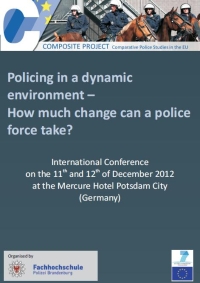 |
Numerous change processes in most European police forces try to address these challenges, and most police officers feel subjected to a never ending stream of reforms and reorganisations, new rules and technologies, challenges and demands. Some of these changes succeed and manage to improve performance, raise commitment, and make people feel safer than before. But some changes fail to do so: They destroy rather than build commitment, they lead to a deterioration of professionalism and performance, they destroy trust, and they accrue unexpected costs.
How can these divergent demands be reconciled and the dilemmas described above be solved? What are the factors that determine success or failure of change processes? What can we learn from more than 20 years of ambitious change processes in most European countries? How important is organisational culture? What role do external stakeholders play? Are there different types of police forces – types that are more open to change and others that are more conservative and traditional?
The international conference “Policing in a dynamic environment – how much change can a police force take?” aims at addressing these issues, bringing together practitioners and scholars, politicians and leaders, researchers and academics to discuss risks and challenges, problems and solutions, theories, typologies, and best practices.
The conference will be hosted at the Mercure Hotel in Potsdam (Germany) on the 11th and 12th of December 2012 and is organised by the German COMPOSITE country team of the University of Applied Sciences of the State Police of Brandenburg (Germany), leader of COMPOSITE’s Action Line III (Knowledge Dissemination and Transfer) and in charge of working package 9 (Dissemination).
The conference programme and the registration form can be downloaded:
The registration deadline of the conference is on the 7th of December 2012. Registration for the evening event at "Bornstedt Crown Estate" on the 11th of December is possible until Wednesday, 28th of November, due to administration reasons.

Copyright © 2012 Max Muster | Created by fruitMEDIA