- Home
- Project
- Partners
- Events
- In the News
- Results
- Links
- Services
- Partner Login
- Press Release
- COMPOSITE Police Monitor
- Impressum
- Gallery
- Photo Project
- Practitioners Conference

In the news...
2014-07-11 13:43
COMPOSITE workshop by Spanish country team
Front End Login
COMPOSITE "Bits-and-Pieces"
2012-09-04 13:04
Influential without Formal Authority: The Role of the Citizens as Powerful External Parties in European Policing.
More than 400 police officers in ten European countries were asked for the key external parties (individuals, groups or organisations) that were regarded as influencing police work. In this context, citizens were stated as one of the most important. The police officers we interviewed were also asked to assess the following on a scale of 1 to 7:
- if the external party had formal authority over the police activities,
- if the external party had a high influence on the police activities,
- if the external party had a good understanding of policing,
- if the external party’s expectations were highly predictable and,
- if the police performed well in terms of satisfying the external parties’ expectations.
Interestingly, there remains a huge gap between the perceived level of formal authority and the perceived level of influence. Even though the police officers interviewed assessed the formal authority of the citizens over their activities as very low, they rated the citizens’ overall influence on police activities as high. The influence of the citizens was regarded as equally important as that of governments or judicial bodies. The following chart illustrates how the position of citizens as external partners when assessed across the individual European countries.
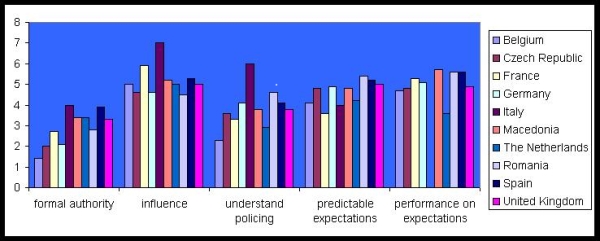
Position of the citizens as external partners across the ten European countries
In a democratic Europe, the various national and municipal police forces become increasingly citizen-oriented and therefore, have to actively manage citizens’ expectations. The results of the interviews indicate that this aspect of police work is more difficult than anticipated because of the fact that, from a police officer´s perspective, the average citizen does not possess a good understanding of police work. The police officers interviewed, also repeatedly mentioned a medium level of predictability regarding citizens’ expectations. Nonetheless, the respondents themselves rated the management and satisfaction of the citizens’ expectations as highly positive.
The correlation between the features of the external parties’ show, that it is challenging to meet the expectations of (a) external parties that understand policing well and (b) external parties with expectations that are unpredictable. Summarising these results, we can postulate that citizens play an important role as external parties for police forces across Europe. While on the one hand, the expectations of the citizens towards the police are sometimes unclear, on the other hand, the police cannot realistically meet unpredictable expectations. Also, we can assume that it may be even more difficult to manage the expectations of an external party that possesses a good understanding of policing. Mainly because this external party has very clear ideas surrounding how its expectations should be managed by the police.

Copyright © 2017 Max Muster | Created by fruitMEDIA